
Tony Kozycki
July 9, 2026 · Newsletter
THE STORIES I CARRIED HOME
The Stories I Carried Home
Why one family’s tragedy finally compelled me to write about the families I’ll never forget.
By Tony Kozycki
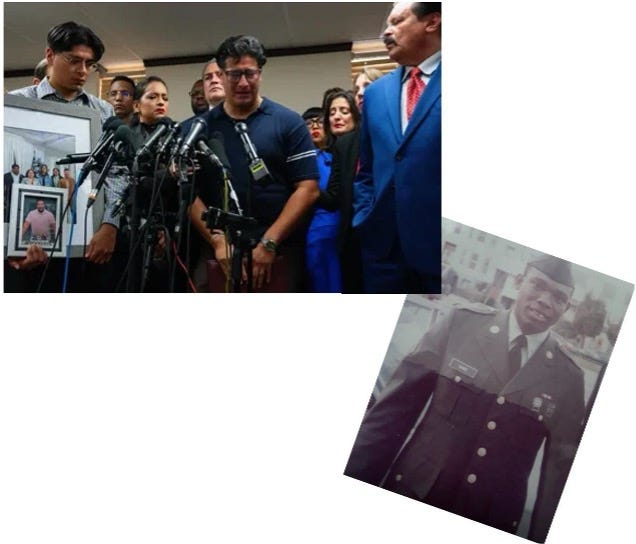
When I saw the photographs of Lorenzo’s sons, I couldn’t stop thinking about the families I had come to know through my work.
For more than a decade, my family has practiced immigration law together. Day after day, we have had the privilege of helping people build lives in the United States. We have celebrated citizenship ceremonies, reunited husbands and wives after years apart, and watched parents achieve dreams they had spent decades pursuing. It has been some of the most meaningful work of my life.
But immigration law also brought me into some of the hardest moments a family can experience.
I never met Lorenzo. I didn’t know his family. Yet the moment I read what had happened, I wasn’t seeing strangers.
I was seeing the children who colored quietly in the corner of our conference room while their parents struggled to answer questions no family should ever have to face.
I was seeing husbands and wives trying to stay strong for one another as they searched for reasons to believe everything would somehow be okay.
I was seeing fathers wondering whether they would still be home to tuck their children into bed a month later.
For most people, stories like Lorenzo’s are heartbreaking headlines. They dominate the news for a few days before giving way to the next story.
For me, they have faces. They have names.
And long after the headlines fade, they stay with me. The stories never stayed at the office.
I carried them home.
People often ask what led me to immigration law. The truth is, it wasn’t part of some carefully planned career path.
After graduating from the United States Naval Academy, I spent the next ten years serving in the Navy, flying in three combat deployments over Iraq, Afghanistan, and Syria. Those years shaped nearly everything I believe about duty, responsibility, and service. In the military, our mission was clear. We defended our country, trusted one another, and were expected to uphold the values that made America worth defending. Politics never entered the cockpit. No one asked whether you were a Republican or a Democrat before a mission. We were simply Americans entrusted with a responsibility larger than ourselves.
When my military service came to an end, my wife and I returned home to Georgia. She had already built an immigration law practice, and after graduating from law school, I joined her.
This isn’t an attempt to explain politics. It’s an attempt to explain how I got here.
When I first began practicing immigration law, much of the work was joyful. We celebrated families finally being reunited. We watched people become citizens after years of sacrifice. We saw businesses started, children thrive, and dreams fulfilled.
Over time, though, something changed.
The people walking through our doors hadn’t changed. Their hopes were the same. They wanted to work, raise their children, and contribute to the communities they loved.
What changed was the fear they carried with them.
I could often recognize it the moment they walked into our conference room.
Sometimes it was a mother gripping her child’s hand so tightly her knuckles turned white.
Sometimes it was a father trying to convince everyone, including himself, that everything would be okay before quietly breaking down.
Children would sit in the corner with crayons and coloring books, blissfully unaware that their parents were wrestling with the terrifying possibility that their family might soon be separated.
As lawyers, we’re trained to remain composed. Clients depend on us to think clearly, explain the law, and guide them through difficult moments.
But no amount of training makes you immune to human suffering.
One afternoon, my wife was tied up in immigration court and asked if I could cover an interview for a family she described as wonderful. I met them in the waiting room. We talked about our children while we waited. We laughed about the chaos of raising young kids. Nothing about that afternoon suggested what was about to happen.
Partway through the interview, the officer asked to speak with the wife alone. At first, nothing seemed unusual.
Then the door opened.
Several masked officers entered the room. She was placed under arrest.
Everything changed in an instant.
A few moments later, an officer looked at me and quietly said something I don’t think I’ll ever forget.
“You need to go tell her husband.”
I can still remember opening that door.
He was sitting exactly where I had left him. Still waiting.
Still believing they were about to finish the interview and go home together. I knew that in the next few seconds I was about to change his life forever.
There are moments when being an attorney means far more than understanding statutes or explaining legal procedures.
Sometimes it means standing beside someone on the worst day of their life.
We fought for that family with everything we had. Lawyers, friends, and people from very different political backgrounds stepped forward to help. We made calls, drafted legal memoranda, explored every possible avenue, and refused to give up.
That experience taught me something I’ll never forget. Compassion doesn’t belong to one political party.
Two months later, another story would find its way into my life.
I read a headline about a Georgia Army veteran being held in immigration custody. His name was Godfrey Wade.
As a Georgia immigration attorney and a combat veteran, I couldn’t simply turn the page.
I reached out because I believed he deserved something simple: the opportunity to have his case heard.
Over the months that followed, I came to know his family well. They never asked for special treatment. They never asked anyone to ignore the law. They simply wanted someone to listen.
More than 1,500 people eventually signed a petition asking that Godfrey be given the chance to present his case before a judge. People from different political backgrounds, veterans, community leaders, neighbors, and strangers all came together around one simple belief: every person deserves a fair process.
For a while, I believed that if enough people understood his story, someone would take another look.
In the end, every avenue we pursued came to an end. Godfrey was deported.
I remember sitting quietly after learning there was nothing more we could do. Not ready to give up, I made one final effort.
Because Godfrey was a veteran, I had reached out to Congressman Rich McCormick’s office early in the process. McCormick being a fellow veteran, I assumed he would be eager, or at least willing, to help a veteran. We weren’t asking anyone to ignore the law or grant special treatment. We were simply asking that Godfrey be given an opportunity to present his case before a judge, which has wrongfully never happened.
After Godfrey was wrongly deported, I went back to McCormick one last time.
By then, more than 1,500 people had signed our petition. Many of them lived here in our own congressional district. They came from different backgrounds and different political beliefs, but they shared one simple conviction: this Army veteran deserved one day in court to tell his story.
I hoped that the voices of more than 1,500 constituents, asking only for a fair process, would be enough.
It wasn’t.
McCormick’s staff gave a very firm no way.
I sat with that answer for a long time.
Up until then, running for Congress had never been part of my plan. I loved practicing law, and I believed that helping one family at a time was enough. But after years of walking alongside families whose lives had been turned upside down, and after exhausting every avenue I knew to pursue for people I believed deserved to be heard, I found myself asking a question I had never seriously considered before.
If not me, then who?
Looking back now, I realize those stories had been changing me long before I recognized it. They forced me to see immigration not as an abstract political debate, but as a deeply human one. Behind every case number was a family. Behind every file on my desk was a story. Behind every legal question was a child, a spouse, or a parent trying to hold a family together.
That question ultimately led me to run for Congress. Not because I was searching for a title.
Not because I wanted a career in politics.
But because I had reached a point where I felt a responsibility to try to address the larger problems I had spent years witnessing one family at a time.
When I saw Lorenzo’s story, every one of those memories came rushing back. I thought about the children who had colored quietly in our conference room.
I thought about the husband waiting outside an interview room, believing he was about to go home with his wife.
I thought about Godfrey’s family trying to imagine life with an empty chair at the dinner table. And I thought about Lorenzo’s sons.
I don’t pretend to have all the answers. Reasonable people can disagree about immigration policy, border security, and how our laws should be enforced.
But I hope we never become so consumed by those debates that we stop seeing the people living inside them.
Behind every headline is a family. Behind every statistic is a child.
Behind every case file is a human being.
If my children ever read these pages years from now, I hope they understand that this was never about politics for me.
It was always about people.
And if there’s one lesson these families have given me, it’s this:
The measure of a nation is not only found in the laws it writes, but in the humanity it shows to the people whose lives those laws touch.
Those are the stories I carried home. They always will be.
Thanks for reading! Subscribe for free to receive new posts and support my work.
Thanks for reading! This post is public so feel free to share it.